
This article will cover the 2nd topic ( Supply of Money , its definition and measures) of 3rd unit Money and banking class 12 AHSEC completely along with the practice questions. It provides relevant and more than enough content on this topic for the purpose of AHSEC Class 12 Economics : Supply of Money topic.
AHSEC Class 12 Economics : Supply of Money
1. What is the Supply of Money?
The Supply of Money is the total volume of money held by the public at a specific point in time. It represents the total money in circulation within an economy.
- Includes: The public (private individuals, business persons, etc.).
- Excludes: Producers of money such as the Central Bank (RBI), the Government, and Commercial Banks.
💡 Key Concept: Money Supply is a Stock Concept. This means it is measured at a particular point in time, unlike a flow concept which is measured over a period of time.
2. Determinants of Money Supply (AHSEC Class 12 Economics Supply of Money)
Currency issued by the central bank and the government held by the public (Cp) plus the reserves held by commercial banks (R). Also called Reserve money or monetary base.
The money multiplier reflects how much the money supply in an economy expands based on the initial deposit or High Powered Money injected by the central bank.
3. Measures of Money Supply (M1, M2, M3, M4)
The Reserve Bank of India (RBI) uses four distinct measures to calculate the money supply in the economy, ranging from highly liquid to least liquid.
M1 (Narrow Money)
M1 is the simplest and most liquid measure of money supply.
- Currency (C): Held by the public. This includes coins and notes. (Note: Coins and one rupee notes are issued by the Government of India and bear the Finance Minister's signature. All other notes are issued by the RBI and bear the Governor's signature.)
- Demand Deposits (DD): Deposits with commercial banks that are payable on demand through cheques or otherwise. They are generally acceptable and highly liquid.
- Other Deposits (OD): Deposits with the RBI other than those held by the government or commercial banks. It includes:
- Deposits of institutions such as UTI, IDBI, IFCI, NABARD, etc.
- Demand deposits of foreign Central Banks and Foreign Governments.
- Demand deposits of the IMF and World Bank.
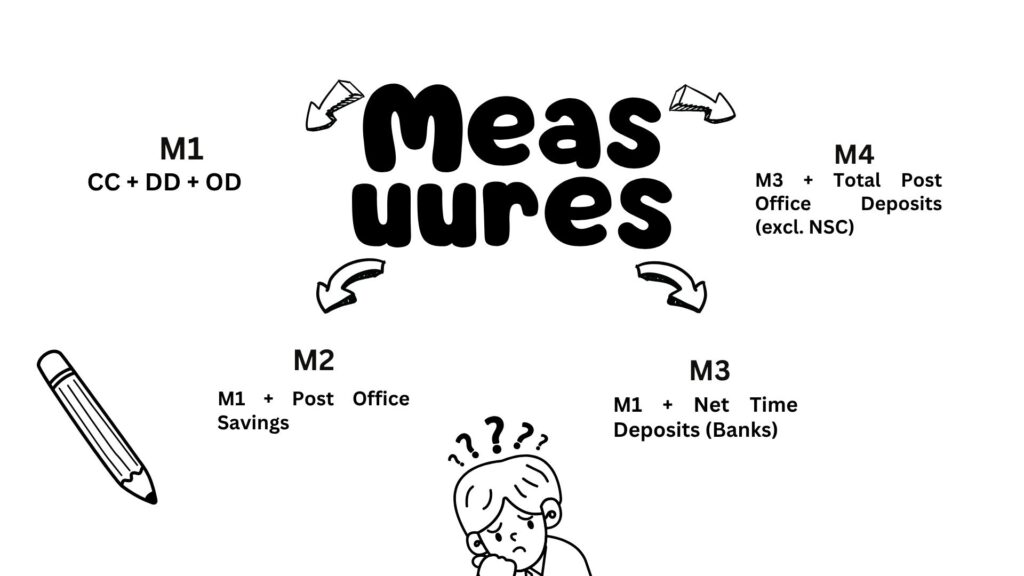
M1 = C + DD + OD
M2
M2 broadens the scope of M1 by including savings accounts from post offices.
M2 = M1 + Saving deposits with Post Office saving banks
M3 (Broad Money)
M3 is the most commonly used measure of money supply for macroeconomic policy-making.
M3 = M1 + Net time deposits with the bank
M4
M4 is the least liquid measure of the money supply.
M4 = M3 + Total deposits with Post Office saving organizations (excluding NSC)
4. Quick Comparison Table
| Measure | Formula / Components | Liquidity Status |
|---|---|---|
| M1 | C + DD + OD | Most Liquid (Narrow Money) |
| M2 | M1 + Post Office Savings | Highly Liquid |
| M3 | M1 + Net Time Deposits (Banks) | Broad Money (Most Used) |
| M4 | M3 + Total Post Office Deposits (excl. NSC) | Least Liquid |
Practice Questions (AHSEC Class 12 Economics, topic:- Money)
Important board exam preparation questions for Class 12 Macroeconomics.
- Who regulates money supply in India ?
- What is Barter System ?
- What is Money?
- What is High Powered money?
- What are the components of High powered Money?
- In which type of money, the face value is higher than the intrinsic value?
- What constitutes fiat money?
- Briefly explain the four functions of Money and how does money overcome the shortcoming of the barter system?
- What is legal tender? Discuss its two types with its example.
- Briefly explain how money evolved from Barter system to digital money.
- What is supply of money?
- Weather money is stock variable or flow variable?
- What does demand deposit means?