This article will cover the complete 3rd unit that is Money and banking of class 12 (AHSEC syllabus). This note will be more than enough for AHSEC Class 12. Previous year questions and the guess question for the upcoming examination will be updated time to time. Read the notes thoroughly and revise it as more as possible.
Meaning of Money — Money and Banking Class 12 Notes
Origin:- The word 'Money' is derived from the Latin word 'Moneta' which means coin.
Standard Definition (Prof. Crowther)
"Anything that is generally acceptable as a means of exchange and at the same time, acts as a measure and a store of value."
Functions of Money — Money and Banking Class 12 Notes
Medium of Exchange
It is the most important function of money. It solves the problem of the lack of the double coincidence of wants that was faced under the barter system.
Measure of Value
Money has also removed the difficulty of the barter system by serving as a common measure of value. The values of various commodities are expressed in terms of money.
Secondary Functions of Money — Money and Banking Class 12 Notes
Store of Value
Money as a store of value is its ability to be saved and exchanged in the future as a purchasing power. People store money generally to meet unforeseen contingencies.
Standard of Deferred Payments
As a result of this function, it has become possible to express future payments in terms of money, enabling the current and present transactions to be discharged in the future.
Transfer of Value
Money is used to transfer the value of commodities from person to person. For example, a landowner will sell the land to another person and get the equivalent value in terms of money.
Money facilitates the distribution of national income among the various factors of production such as wages, interest, rent, and profit in terms of money .
The Demand for Money: Keynesian Liquidity Preference — Class 12 Notes
The demand for money refers to the total amount of financial wealth people and businesses prefer to hold in highly liquid forms—like cash or bank deposits. According to the Keynesian Approach (Liquidity Preference Theory), there are three primary motives for holding money:
Transactions Motive
In order to meet the needs of day-to-day transactions during the time gap, some money is kept aside. The smaller the gap between a person’s receipt and payment, the lesser will be the transaction demand for money.
Precautionary Motive
This refers to the desire of the people to hold cash balances for unforeseen contingencies. It is the tendency of people to hold a certain amount of money to provide for the risk of unemployment, sickness, accidents, and other uncertain perils.
Speculative Motive
This relates to the desire to hold one’s resources in liquid form to take advantage of market movements regarding future changes in the rate of interest (or bond prices).
People desire to gain by purchasing financial assets at a low price and selling them when their prices rise.
Barter Exchange System and Its Drawbacks — Class 12 Notes
Economic exchanges without the mediation of money are referred to as the Barter Exchange System.
It is also called a C-C Economy, where C-C stands for Commodity-to-Commodity exchange economy.
Drawbacks & Shortcomings of Barter System
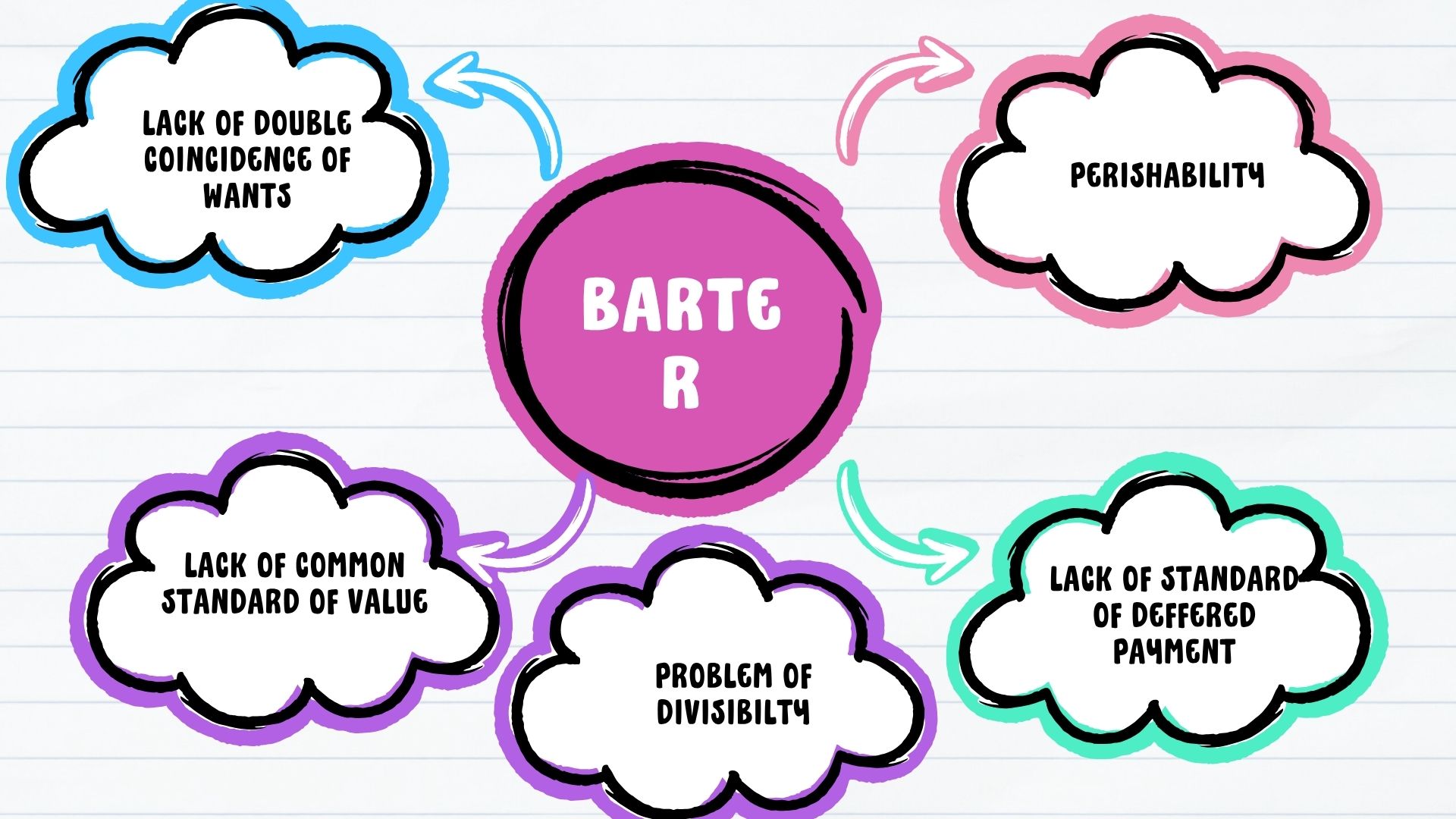
Lack of Double Coincidence of Wants
It is the main disadvantage of this system. It refers to an economic situation where two parties each hold an item or service that the other wants, allowing them to trade directly.
Farmer A
Produces: Wheat
Wants: Rice
Person B
Produces: Rice
Wants: Wheat
Perishability (Store of Value Problem)
Under the barter system, it was difficult to store the value of goods for future use because many commodities are perishable. For example, goods like tomatoes, milk, or fish cannot be stored for a long time without decaying, leading to wealth loss.
Lack of Common Standard of Value
All goods to be exchanged are not of the same value, and there was no common unit of measurement. It was highly complicated to calculate how much rice or wheat equaled the value of one cow. Evaluating thousands of commodities relative to each other was nearly impossible.
Problem of Divisibility
Certain goods cannot be physically divided into smaller pieces without losing their utility. If a person owns a cow and wants to buy a smaller item like a hen or a piece of cloth, they cannot trade a fraction of a living cow, resulting in a severe transaction loss.
Lack of Standard of Deferred Payment
In a barter economy, making payments in the future (contracts, loans, or credit transactions) is highly challenging. Future payments made in goods face severe disagreements regarding matching quality, structural conditions, and shifting values over time.
The Evolution of Money: From Barter to Digital Era
The evolution of money is one of the most significant developments in human history. To understand modern economics, we must look at how the medium of exchange transitioned from a simple barter system to today's advanced digital currencies.This topic comes under the 3rd unit that is Money and banking class 12 notes of board AHSEC
1. Barter System (C-C Economy)
Economic exchanges without the mediation of money are referred to as the barter exchange system. It is also called a C-C economy, where 'C-C' stands for commodity-to-commodity exchange (e.g., exchanging rice for salt).
⚠️ Drawbacks of Barter System:
- Lack of Double Coincidence of Wants: Both parties must need what the other has.
- Lack of Common Measure of Value: No standard unit to price goods.
- Problem of Storage & Portability: Goods suffer from perishability and are hard to carry.
2. Commodity Money
The disadvantages of barter necessitated the introduction of commodity money. A certain commodity was fixed as a measure of value. For example, rice or shells were considered money. This was prominently seen in the Mesopotamian civilization around 3000 BC. However, it still faced issues like portability, durability, and divisibility.
3. Metallic Coins
With the progress of time, coins made of precious metals such as gold and silver were introduced. While highly durable, this created new problems regarding the safety of transport and the scarcity of precious metals.
4. Paper Money
Paper money revolutionized the concept of currency. It solved the problems of portability, durability, and divisibility, offering a much more convenient form of exchange that is widely accepted globally.
5. Banking, Credit, and the Gold Standard
As economies grew, the banking system emerged. Cheque facilities were introduced, and promissory notes were widely used. The Gold Standard system was adopted during this phase to back the value of paper money.
💳 Plastic Money
The introduction of credit cards and debit cards made transactions safer, easier to carry, and highly durable without needing physical cash.
📱 Digital Currency
Cryptocurrencies (like Bitcoin) emerged. Recently, central banks have introduced official digital currencies, such as the RBI's e-Rupee in India.