
To score the maximum marks , understanding the official AHSEC class 12 Economics syllabus and chapter wise weightage id necessary. Here below , I have decoded the entire syllabus and broken down the high-weightage chapters, core concepts, and provided direct links to my precise, easy-to-understand chapter notes and downloadable PDFs to help you score a 90+ easily.
Table of Contents
Toggle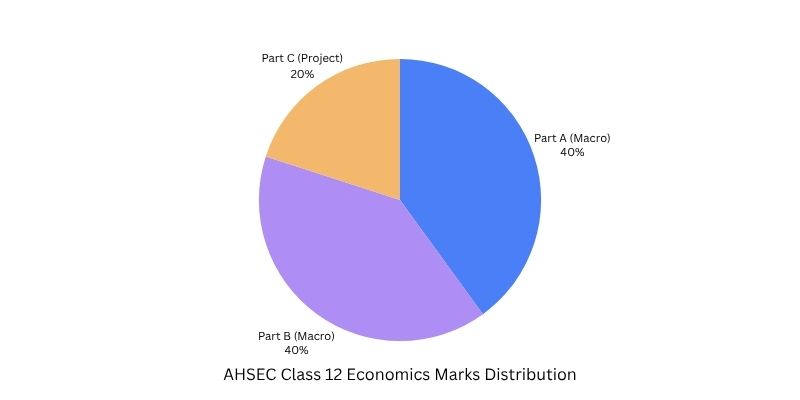
ECONOMICS
SYLLABUS FOR HIGHER SECONDARY FINAL YEAR COURSE
Marks 100 [ (80 Theory) + 20 (Project) ]
Unit wise Distribution of Marks and Periods :
Part A : Introductory Macroeconomics
| Unit No. | Title | Marks | Periods |
|---|---|---|---|
| 1 | National Income and Related Aggregates | 10 | |
| 2 | Determination of Income and Employments | 12 | 22 |
| 3 | Money and Banking | 06 | 12 |
| 4 | Government Budget and the Economy | 06 | 12 |
| 5 | Open Economy | 06 | 14 |
| Total | 40 | 90 |
Part B : Indian Economic Development
| Unit No. | Title | Marks | Periods |
|---|---|---|---|
| 6 | Development Experience (1947-1990) | 07 | 13 |
| 7 | Economic Reforms since 1991 | 05 | 10 |
| 8 | Current Challenges facing Indian Economy | 22 | 55 |
| 9 | Development Experiences of India: A comparison with neighbours | 06 | 07 |
| Total | 40 | 85 |
| Part C : | Project Work in Economics | 20 | 20 |
For more detail breakdown of the syllabus of AHSEC Class 12 Economics , please check our individual chapter syllabus and notes listed below . I have also attached the official AHSEC Class 12 Economics syllabus Link below
📚 Download AHSEC Class 12 Economics Chapter Wise Notes
Click on any chapter below to read the precise notes and download the official PDF.
📘 Part A: Introductory Macroeconomics (Chapter Links)
- 📂 Unit 1: National Income and Related Aggregates Coming Soon
- 📂 Unit 2: Determination of Income and Employments Coming Soon
- 🔥 Unit 3: Money and Banking 👉 Read Notes
- 📂 Unit 4: Government Budget and the Economy 👉 Read Notes
- 📂 Unit 5: Open Economy Coming Soon
📙 Part B: Indian Economic Development (Chapter Links)
- 📂 Unit 6: Development Experience (1947-1990) Coming Soon
- 📂 Unit 7: Economic Reforms since 1991 Coming Soon
- 📂 Unit 8: Current Challenges facing Indian Economy Coming Soon
- 📂 Unit 9: Development Experiences of India: A Comparison Coming Soon
Detailed Course Content of AHSEC Class 12 Economics
Unit 1: National Income and Related Aggregates
- Macroeconomics: Meaning, emergence of macroeconomics; Major sectors in an economy (Household, Firms, Government, External).
- Basic concepts in Macroeconomics: Consumption goods, capital goods, final goods, intermediate goods; stocks and flows; Investment, Gross investment, Net investment, and depreciation.
- Circular flow of income: Two-sector model.
- Methods of calculating National Income: Value-added or Product method, Expenditure Method, Income Method.
- Price Concepts: Factor Cost, Basic Prices, and Market Prices.
- Aggregates related to National Income: Gross National Product (GNP), Net National Product (NNP), Gross Domestic Product (GDP), and Net Domestic Product (NDP) - at market price, at factor cost; Personal Income, Personal Disposable Income, National Disposable Income, and Private income; Real and Nominal GDP.
- Welfare: GDP and Welfare.
Unit 2: Determination of Income and Employment
- Aggregate Demand: Aggregate demand and its components.
- Propensities & Functions: Consumption function, Propensity to consume and propensity to save (average and marginal), Investment function.
- Income Determination: Income determination in a two-sector model.
- Short-run Equilibrium: Determination of Equilibrium Income in the short run; macroeconomic equilibrium with price level fixed; effect of an autonomous change in aggregate demand on income and output; investment multiplier and its mechanism.
- Employment Levels: Meaning of full employment, Deficit demand, excess demand.
Unit 3: Money and Banking
- Money: Meaning and its functions; Demand for money; motives for demand for money.
- Supply of Money: Supply of money; Various measures of supply of money.
- Central Bank: Central bank and its functions.
- Commercial Banks: Meaning and functions; Credit creation by the commercial banks; Limits to credit creation and money multiplier.
- Policy & Events: Policy tools to control money supply; Demonetization.
Unit 4: Government Budget and the Economy
- Government Budget: Meaning, objectives, and components.
- Receipts Classification: Revenue receipts and capital receipts.
- Expenditure Classification: Revenue expenditure and capital expenditure.
- Budget Balance Types: Balanced Budget, Surplus Budget, and Deficit Budget.
- Deficit Correction: Measures to correct government deficit - Fiscal Policy: Changes in government expenditure and changes in tax, public debt; Fiscal Responsibility and Budget Management Act, 2003; GST (Concept only).
- Deficit Measures: Revenue deficit, Fiscal deficit, Primary deficit.
Unit 5: Open Economy
- Balance of Payments: Meaning, Current Account, Capital Account, Balance of Payments surplus and deficit.
- Foreign Exchange Market: Foreign exchange rate: fixed exchange rate, flexible exchange rate, and managed floating exchange rate.
- Rate Determination: Determination of foreign exchange rate under fixed and flexible exchange rates.
- Evaluation: Merits and demerits of flexible and fixed exchange rates.
Unit 6: Development Experience (1947-1990)
- Independence Eve: A brief introduction of the state of the Indian economy on the eve of independence.
- Planning: Indian economic system and common goals of Five-Year Plans.
- Agriculture: Main features, problems, and policies of agriculture (institutional aspects and new agricultural strategy).
- Industry & Trade: Industrial Policy Resolution 1956; Small Scale Industry — Role and Importance; Trade Policy — Import Substitution.
Unit 7: Economic Reforms since 1991
- Rationale: Rationale of Economic Reforms; Liberalisation, Privatisation, and Globalisation; Appraisals of economic reforms in India.
- LPG Policy Features: Features and appraisals of liberalization, globalization, and privatization.
Unit 8: Current Challenges facing Indian Economy
- Human Capital Formation: Human capital, Sources of Human capital, Human Capital and Human Development, State of Human Capital Formation in India, Education Sector in India.
- Rural Development: Key Issues — credit and marketing in rural areas; Agricultural market system, Diversification into productive activities, Sustainable development, and organic farming.
- Employment: Growth and changes in workforce participation rates in formal and informal sectors; problems and policies.
- Environment & Sustainability: Environment — Definition and functions; Sustainable development — meaning, strategies for sustainable development, nature of environmental challenges facing India.
Unit 9: Development Experiences of India: A Comparison with Neighbors
- Comparative Countries: India and Pakistan; India and China.
- Comparative Issues: Demographic indicators, Economic growth, Sectoral Development, and Human Development Indicators.