This post covers the last component of the first topic of class 12 AHSEC economics syllabus that is components of government budget. This article covers all the relevant aspects of this topic under the title “Components of Government Budget, Class 12 AHSEC Economics Notes”. Students are advised to go through concepts 2-3 times and keep doing revise.
COMPONENTS OF GOVERNMENT BUDGET
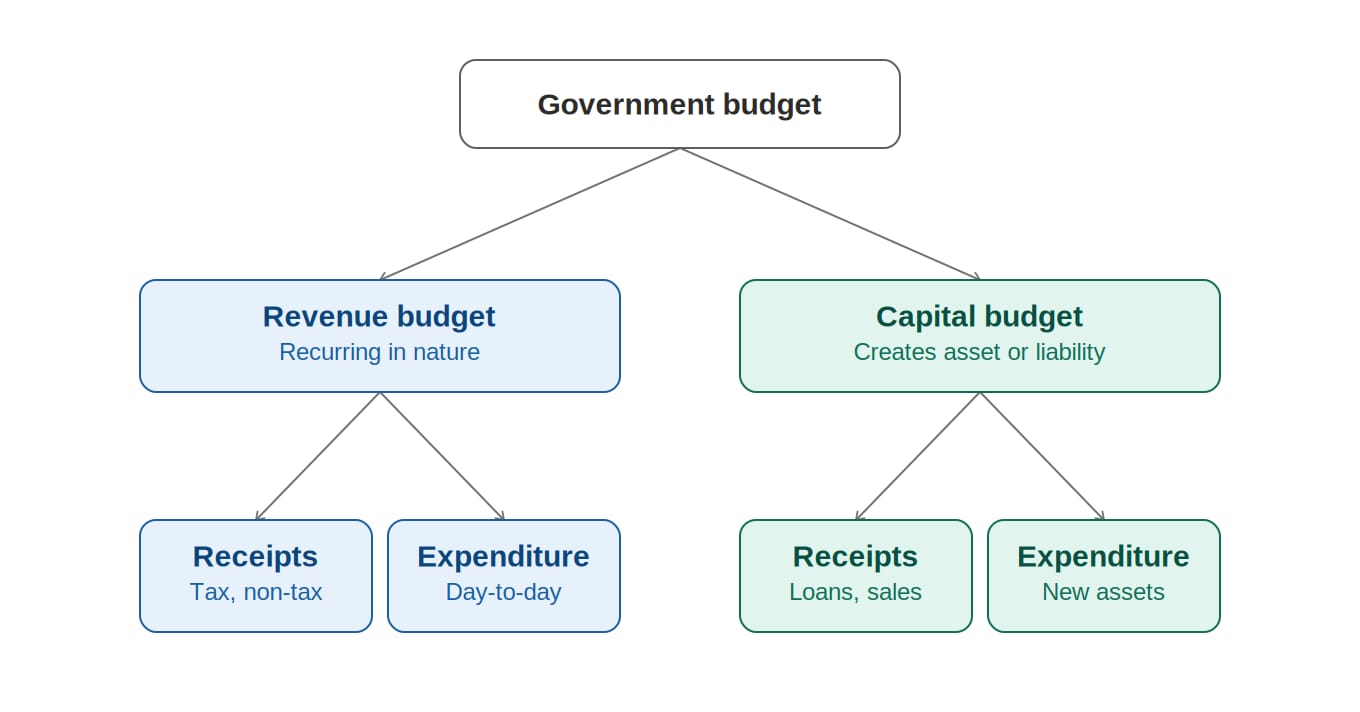
It refers to structure of the budget. Budget can be classified into two types:
- a) Revenue budget
- b) Capital budget
MASTER OVERVIEW
-
GOVERNMENT BUDGET
-
1. REVENUE BUDGET
- A. Revenue Receipts (Tax & Non-Tax)
- B. Revenue Expenditure
-
2. CAPITAL BUDGET
- A. Capital Receipts (Borrowings, Disinvestment, etc.)
- B. Capital Expenditure
-
REVENUE BUDGET(Components of Government Budget)
It deals with the revenue aspect of the government budget.
It is classified into two types:
a) Revenue receipts (Components of Government Budget)
It refers to those receipts which neither creates any liability nor reduces any assets. for eg:- taxes levied by government does not create any liability nor reduces any assets.
SOURCES OF REVENUE RECEIPTS
- 1) Tax revenue: refers to sum total of receipts form taxes and other duties imposed by the government.
- 2) Non-Tax revenue: refers to receipts of the government from all sources other than those of tax receipts. This may be from:
- a) Interest: received by the governments on loans granted.
- b) Profits and dividends: From public sector undertakings.
- c) Fees: court fees, registration fees.
- d) License fee: charged by government for granting permission to do something.
- e) Fines and penalties: for violation of laws.
b) REVENUE EXPENDITURE (Components of Government Budget)
It refers to the expenditure which neither creates any asset nor reduces any liability. For e.g. Payment of salaries, wages and salaries paid by the government, interest payments, subsidies.
CAPITAL RECEIPTS
It refers to those receipts which either creates liability e.g Loan or borrowings or reduces assets eg:- sale of assets.
SOURCES OF CAPITAL RECEIPTS
- a) Borrowings : Borrowings are the funds raised by government to meet excess expenditure. Borrowings are the capital receipts as they create liability for the government.
- b) Recovery of loans: Central government grants various loans to the state governments or union territories. Recovery of such loans is a capital receipts as it reduces the assets of the government.
- c) Disinvestment : It refers to the act of selling a part of the whole shares of Public sector undertakings held by the government. They are capital receipts because they reduce the government asset.
- d) Small savings : Funds collected by issuance of for example National saving certificates, Kisan Bikash Patras etc. They are treated as capital receipts as they increase the liability.
DIFFERENCE BETWEEN REVENUE RECEIPTS AND CAPITAL RECEIPTS
| BASIS | REVENUE RECEIPTS | CAPITAL RECEIPTS |
|---|---|---|
| MEANING | They neither creates any liability nor reduces any assets. | They either creates any liability or reduces any assets. |
| NATURE | They are regular and recurring in nature. | They are irregular and non-recurring in nature. |
| FUTURE OBLIGATION | There is no future obligation to return the amount. | There may be future obligation to return the amount. For e.g Borrowings must be returned. |
| EXAMPLES | Income tax, Fees received. | Borrowing, Disinvestment. |
CAPITAL EXPENDITURE
It refers to the expenditure which either creates any assets or reduces liability. Example : Construction of Bridge or reduces any liability. Example : repayment of borrowings.
DIFFERENCE BETWEEN REVENUE EXPENDITURE AND CAPITAL EXPENDITURE
| BASIS | REVENUE EXPENDITURE | CAPITAL EXPENDITURE |
|---|---|---|
| MEANING | It refers to those receipts which neither creates any liability nor reduces any assets. for eg:- taxes levied by government does not create any liability nor reduces any assets. | It refers to the expenditure which either creates any assets or reduces liability. Example : Construction of Bridge or reduces any liability. Example : repayment of borrowings. |
| PURPOSE | It is incurred for day to day business running. | It is incurred mainly for acquisition of assets or liability reduction. |
| NATURE | Recurring in nature. | Non-recurring in nature. |
| EXAMPLES | Salary, Interest paid etc. | Expenditure on Hospital building. Etc. |
TAX
Tax is a compulsory payment. A taxpayer can't expect that the tax amount will be used for his direct benefit.
TYPES OF TAXES
- a) Direct tax:- It refers to those taxes where impact and incidence lies on the same person. It is generally imposed on the income of the person.
- b) Indirect tax::- It refers to those taxes where impact and incidence are not on the same person. It is generally imposed on the goods and services.
DIFFERENCE BETWEEN DIRECT TAXES AND INDIRECT TAXES
| BASIS | DIRECT TAX | INDIRECT TAX |
|---|---|---|
| DEFINITION | It refers to those taxes where impact and incidence lies on the same person. | It refers to those taxes where impact and incidence are not on the same person. |
| IMPACT | Direct taxes are levied on individuals and companies. | Indirect taxes are levied on goods and services. |
| SHIFT OF BURDEN | The burden of direct tax can not be shifted. | The burden of indirect tax can be shifted. |
| NATURE | They are generally progressive in nature. | They are generally proportional in nature. |
| COVERAGE | They have limited reach as they don't reach all the sections the economy. | They have a wide coverage as they reach all the sections of the society. |
| EXAMPLE | For e.g. Income tax | For e.g. Goods and services tax (GST) |